Scelerisque pulvinar gravida cursus morbi enim faucibus amet. Netus felis ipsum lorem consequat aliquet. Ullamcorper lacus eu morbi purus. Porttitor mauris tincidunt volutpat pharetra scelerisque. Velit non molestie pulvinar aliquam aliquam id libero cras. Mattis ornare egestas at interdum gravida feugiat. Nisi elementum nisl consectetur nec. Et lectus purus gravida tortor consequat cras sit luctus. Nunc feugiat in faucibus dolor. Proin aliquet id nisi quis cursus dignissim facilisis.

In Rome, it's easy to find something marvelous to admire when you lose your way. Traipse down some cobblestone alley off a main square intending to take a short cut and chances are you'll find yourself enthralled by something not on any tourist map. Maybe it's a cascade of bougainvillea tumbling over a railing of a terrazzino in passionate pink, or an untamed branch of wisteria in all its lilac, sweet lushness. Or the sound of water splashing playfully from some fanciful architecture, like the fountain with turtle statues in a tiny square near medieval palazzi and close to the old Jewish Quarter's history-drenched main street.
Even Romans sometimes are startled by something seemingly new in their Eternal City. You can't blame Rome commuters if for decades, hurrying to metro stop called Piramide, they paid scant attention to one on Rome's ancient glories. The Cestia Pyramid, which lends its name to the bustling subway stop, is the only one of four pyramids built in Roman empire times, reflecting a fad then for Egyptian culture. But for years more than a glory it bordered on being an eyesore. Grime and exhaust coughed up by cars, buses and trucks in one of the city's busiest intersections had coated the 1st-century A.D. monument, constructed during the glory days of the Augustine Emperor, a dingy gray. The layers of dirt and dust covered the rich, creamy white Carrara marble that adorned the exterior of the 120-foot-high pyramid, built as final resting place for a Roman politician to honor his wishes in his last testament.
The monument had a depressing air – tourists barely paid it heed.
Then, a few years ago, a Japanese textile and clothing magnate donated $2 million to clean the Pyramid. When the scaffolding came off – ahead of schedule, a rare feat in a city which always runs late, and likely reflecting Japanese fondness for efficiency – the Pyramid seemed startling new.
Inside the monument, accessible by crouching through a low-sitting tunnel, is a frescoed space where the praetor's burial urn once stood. Restoration workers inside the burial chamber – frescoed in Pompeii style – explored a tunnel that archaeologists believe was used by grave-robbers –tombaroli they are called in Italian now – to ransack the burial place in medieval times.
Small guided tours are give on two Saturday's month, reservations only. Those on the tour will step across a modest stone ``doormat" inscribed with the Japanese patron's name.
While you will need to look up to admire the restored splendor of the Pyramid, other marvels in Rome are sometimes tucked away behind something as mundane as construction barriers. In Piazza Venezia, the traffic-clogged heart of modern Rome, the remains of a medieval building were unearthed during construction work to expand Rome's quite modest subway system.
Peer over the fencing in a corner of the Piazza close to Trajan's Colum, and you can see the fruits of archaeologists, who were alerted to the discovery by construction engineers -- a fairly commonplace event in Rome. The city Romans on today was largely built atop layers of past centuries and civilizations. Buried under Renaissance era buildings are streets and apartments from medieval days, and farther down that layer, digging often reveals an ancient Roman domus or dwelling, sometimes several of them.
In the case of Piazza Venezia's dig, that's what happened. Nearest to street level are parts of Renaissance Rome. Under that is part of a medieval street road which ran through the city. And under that, archaeologists found pavement from the 8th century.
Other finds during construction work for the subway include a 6th-century copper factory and medieval kitchens with their pots and pans.
The discovery scuttled planner's goal of putting subway entrances and exits right on the square, meaning when the extension of the subway ever does get completed, Romans will have to walk a bit out of their way to access it.
You can't walk through this archaeological discovery, but right around the corner, you can go subterranean.
There, under 16th-century Palazzo Valentini, which now is open to the public doing businesses in offices of Rome's province, is an extensively excavated Roman domus. Tours in English, and in small groups, are currently given three times daily, with reservations strongly recommended. Tourists can admire the residence of a powerful family in Imperial times, perhaps of a senator. Mosaics, wall decorations, multi-colored floors, and peristyles are among the sights. The tour was recently extended to include the underground area opposite Trajan's Column, including the remains of what was once a monumental public or perhaps sacred building.
It's a fascinating world, a silent attraction below the chaotic bustle of Piazza Venezia. Many Romans are unaware of its existence as they dash for buses or cabs at the taxi stand in the square.
A friend of mine who is a fellow longtime Rome resident recently started to excitedly recount a new discovery in the heart of the city. I invited her to share the excitement with you, and here is her account:
Pocket parks, those petite oases tucked between skyscrapers, are so vital to city-goers in need for quick respites from metropolitan madness that they are now the stuff of guidebooks.
In Rome, such little islands of tranquility are a rarity, unless, perhaps, you happen upon a cloister hidden inside a convent or monastery, and the nuns or monks will let you linger there.
Rome, with its noisy herds of motorini, could certainly use a pocket park. To my delight, I discovered it now has one of the loveliest ones I could imagine, and right smack where perhaps it is needed most: in its chaotic heart, Piazza Venezia. For months I had rushed right past it with 'nary a glance, as I hurried down Via degli Astalli, past one of the garden's, three entrances as I raced to catch the tram home from work, or, more often, dashed from tram to work.
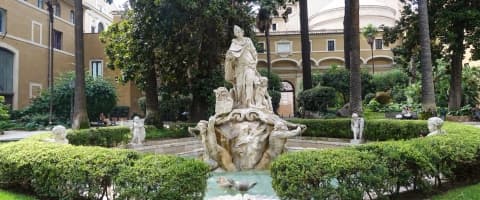
For many long years, tall, dark brown, almost forbidding-looking doors blocked the entrance on Via degli Astalli to all but those who worked inside Palazzo Venezia, a 15th-century building that is considered Rome's first great Renaissance palace, and which was built for the future Pope Paul II. But suddenly I noticed the doors, in daytime, every day, were wide open, offering entree to an amazing "secret garden" of towering palms, whimsical fan-tailed stone fish sculptures adorning a central fountain, and – wonder of wonders -- stone benches where one can sit and chat, relax in silence or close one’s eyes and dream.
Until recently, the courtyard garden had been, in the words of Sonia Martone, a parking lot for employees in the complex, but when the cars and motorini vanished for the night, the space "transformed itself into an island of peace in the most chaotic point of Rome." Martone is the new director of the National Museum of Palazzo Venezia, Rome's decorative arts museum, itself a largely undiscovered gem in the city's art attractions.
Thanks to the garden, the museum, housed in the palace which surrounds it is now getting more notice. This summer the garden was the setting for a series of evenings of entertainment dubbed "the found-again garden." Among the popular offerings were dance, jazz, a chat with an art expert after a visit to the museum led by Director Martone.
The garden itself was designed to give relief from work. Martone notes in her comments on a museum web site that in the early 18th-century the fountain was commissioned so the palace's inhabitants wouldn't have to go to the public square for their water supply.
Please stop by this wonderful pocket park while you are in Rome. It is definitely worth a visit.
Ok...these sandals were definitely "MADE IN ITALY!" Antonio Viva has been at it since 1958 at his shop, ‘L’Arte del Sandalo Caprese’ on via Giuseppe Orlandi al n 75 in the center of Anacapri on the island of Capri. His fame reached Hollywood making his designs a must have back in the “Dolce Vita” days for the likes of Jackie O and Sofia Loren.
The ancient art of sandal making goes back to the Greeks and, indeed, even the earlier Egyptians were no strangers to sandals. What proved to be the innovative edge was the invention of the hard sole with leather straps. Ever the pragmatists, the Romans designed sandals tough enough for military expeditions. This ‘modern’ twist apparently held sway with the likes of Emperor Tiberius. the first Emperor to don the hard-soled that came to be known as the ‘sandalium’ and later the sandal. Since he made Capri his summer home, the island has been attributed with the creation of the new footwear.
Over the course of the years, the artisans of Capri, with the aid of the islands natural beauty, created an unmistakable style that is now known world wide. Not much has changed regarding the hard sole; what is different are the shades of gold and silver leather, turquoise and fuscia gems, pearls and rhinestones and the low heels that are one of the many options that make each pair of sandals unique. And Antonio Viva, as his name suggest, is keeping the tradition alive. His small laboratory, completely open to the street is the quintessential shop experience. One is overcome with the variety of colors with a myriad of gems and colored straps that make you want to don your feet with one of his creations as soon as possible. In fact, his assistant will call out to clients saying, “don’t worry, just choose your model and your sandals will be ready on your way back form the stroll!” This very Italian invitation usually works and many a happy tourist is seen winding down to Capri’s dock with a pair of Viva’s sandals in hand.

Judy Witts Francini put up a photo on Instagram yesterday of a dish called ‘pesce finto’, meaning ‘fake fish’. I am not sure it’s the sort of recipe that would appeal to people outside Italy. Which is a shame because I, and Judy evidently too, think it is quite delicious, not to mention easy to prepare. Basically it is tinned tuna and mashed potatoes … both usually a staple in any home.
I wrote a post about it a few years ago which I don’t mind reposting. The recipe is my tweak on this recipe which also includes burrata – and so many people I know adore burrata: https://myhomefoodthatsamore.wordpress.com/2013/05/31/faking-fish-il-pesce-finto/
I hope you enjoy reading about this Italian nursery food comfort dish. Who knows, you might even be prompted to try it out.
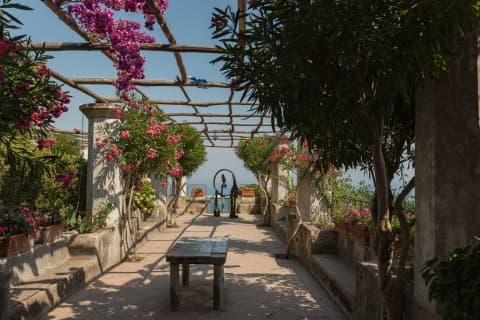
On a recent trip to the Amalfi Coast I discovered the jewel of Villa Rufolo in the town of Ravello. Although situated in the center of town, the Villa is hidden from view rewarding the unsuspecting visitor with the most pleasant of surprises.
A palatial estate built in 1270 for the wealthy Rufolo family, Villa Rufolo was one of the largest and most expensive villas on the Amalfi Coast, and legends grew about treasures hidden on its premises.
Composed of two main towers and a magnificent cloister, all in the Moorish style with the details and textures one would expect of Islamic architecture, it is known as a miniature Alhambra. Walking through the main tower and cloister, with its alluring patterns and architectural detail, once would expect to find the desert-like surroundings of the middle east. Instead what awaits the visitor is one of the most magnificent gardens imaginable.
Juxtaposed against the sea and sky, the lush vegetation, burst of colorful flowers, cast iron trellises and sculptures create a magical oasis. The soft breezes and quiet rustling of the umbrella pines create an atmosphere that has for centuries been a source of inspiration for artists of all inspirations,
The German composer Richard Wagner stayed in Villa Rufolo while writing the second act of his final opera, Parsifal. Today, his spirit lives on in the unique annual music festival for which the Villa and town of Ravello are famous worldwide. The “City of Music” summer concert series features piano concerts, chamber music and a grand orchestral performance on a stage built jutting out over the Mediterranean Sea. I can’t imagine a more beautiful setting for orchestral music seemingly hosted gracefully by Villa Rufolo itself. This and more on the Amalfi Coast when travelling with Your Own Italy.
Venice's Ghetto marks 500 years of fascinating, culturally rich history
Perhaps because you often have to cross a bridge or two to reach them, neighborhoods in Venice can seem to be worlds of their own. The lagoon city is officially divided into six "sestrieri' or quarters, and within each one, it's enough to walk under a "sottoportico" (a pedestrian walkway under private buildings) and, scamper across bridges over a "rio," or small canal, to discover what seems to be different territory. Even the slant of light can feel different from one "sestriere" to another..
Venice's Ghetto neighborhood in the Cannaregio sestriere qualifies as one of the city's most singular places -- indeed, it can rank among the world's most fascinating historical areas. Celebrating this cultural treasure, Venice and Jewish communities are highlighting the Ghetto's history and contributions to the city and beyond with events and exhibits to mark the 500th anniversary of its establishment.
(A Jewish cemetery. on the Lido, dates back even more, to the late 14th century, reflecting generations of Jews, many of them merchants who were allowed to work in the city although forced to pay a special tax on import and export business deals.)
On March 29, 1516, after Jews who were fleeing to Venice from expulsions in Spain and Portugal, swelled the Jewish population in the city, the-then proud and powerful Venetian Republic, in a reflection of geo-political forces, ordered the city's Jews to live in an island area where a foundry had been. Different explanations are offered for the origin of the name "Ghetto," with much consensus centering on the Italian word "getto" meaning to cast metal, as a foundry would.
Later, the label "ghetto" would identify other areas where the Jews would be confined, including the Tiber-side neighborhood in Rome. The word also evolved to signify where any identifiable group would live, segregated.
At midnight, the Venice Ghetto's gate was locked shut, with the Jewish community within forced to pay Christian guardians. Patrol boats also plied the waters surrounding the Ghetto, not far from today's train station, to ensure no Jew left after midnight.
But while strictly enforced, the restriction on the Jews couldn't stop the development of a flourishing, cosmopolitan culture inside. The population continued to grow and be enriched: Jews arrived, fleeing Poland and Germany. Other, turban-wearing Jews, from the Ottoman empire, arrived from Turkey, all enriching the cultural mix, as each group brought its own traditions and religious customs. Since Christians could enter the Ghetto, these Venetians made contact with the culture -- literary, intellectual and artistic -- flourishing within the Ghetto's confines, and took these influences with them when they exited the Ghetto's world.
Visitors today to the Ghetto can see the sottoportico which gave access to the segregated community, where bars were once put in place each night to keep the inhabitants from leaving at night. With the population swelling while the Ghetto was enforced, flats were divided and stories added -- with some buildings nine stories high, practically skyscrapers a half-millennium ago.
Highlights of a visit include stopping in the Ghetto's museum and as well as admiring the ornate furnishings of some of the five "scole" or synagogues, a reflection of the varied traditions each arriving wave of Jews from across much of the continent brought with them.
To mark the 500th anniversary, the Palazzo Ducale, in its Doge Apartment, hosted an exhibit, running through Nov. 13 entitled "Venice, the Jews and Europe 1516-2016." The exhibit offers reflections on linguistic and cultural exchanges, the trades and artisan crafts practiced that the Ghetto's inhabitants shared with the city's Christian population and well as other minorities in what was for its time an extraordinary important commercial center. Paintings by artists ranging from Bellini to Chagall are included in the show.
The Peggy Guggenheim Collection, in collaboration with the Ikona Gallery, organized a photographic show which runs through Nov. 27. The show, ""Peggy Guggenheim in Photographs" pays tribute to the 20th-century art patron, whose namesake palace art museum is a popular attraction along the Grand Canal. Photographers with works in the show include Man Ray, Berenice Abbott and Giselle Freund.
During the summer, the Ghetto hosted the first-ever performance of Shakespeare's "The Merchant of Venice.""
Scholarly seminars, conferences and lectures -- one eight-day conference was called "The Ghetto as a Global Metaphor, and including presentations by lectures from Princeton, Harvard, Yale universities and other educational institutions -- have also been a key part of the program throughout the anniversary year. Activities also include a project to reclaim two abandoned orchards near the Levantine and Spanish synagogues, with the result to be called "Secret Gardens of the Ghetto".
December events include a conference on The Venetian Ghetto in European History and Culture, and another focusing on sacred music of Italian Judaism.
Additional information is available at at www.veniceghetto500.org.