Scelerisque pulvinar gravida cursus morbi enim faucibus amet. Netus felis ipsum lorem consequat aliquet. Ullamcorper lacus eu morbi purus. Porttitor mauris tincidunt volutpat pharetra scelerisque. Velit non molestie pulvinar aliquam aliquam id libero cras. Mattis ornare egestas at interdum gravida feugiat. Nisi elementum nisl consectetur nec. Et lectus purus gravida tortor consequat cras sit luctus. Nunc feugiat in faucibus dolor. Proin aliquet id nisi quis cursus dignissim facilisis.
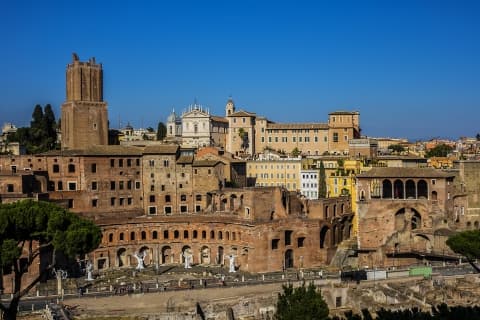
Anniversaries are fitting occasions to review a life, and Rome is doing exactly that with a meticulously documented and attractively displayed show to mark 1,900 years since the death of Emperor Trajan in 117 A.D.. "Trajan, Constructing the Empire, Creating Europe," opened in late fall 2017 and runs until Sept. 16, 2018 in a most logical setting -- the cavernous, restored Markets of Trajan, perched on the lower slopes of the Quirinal Hill.
The exhibit explores the accomplishments and legacy of the emperor who was considered by his contemporaries to be an "Optimus princeps," Latin, roughly, for the best among emperors. As the show's title implies, Trajan was intent upon expanding the ancient Roman Empire, under his rule, which began in 98 A.D., reached its maximum expansion. The empire spanned across northern Africa, and, in Europe, from the Black Sea in the east to the Irish Sea in the west. Curiously, Trajan was the first non-Roman to be Rome's empire. His roots were in what is now referred to as Iberia.
There are some eye-catching sculpted antiquities on display. Among them is a colossal hand and a head depicting Trajan -- both items originate from Trajan's Forum, but more recently were brought to the exhibit from museum storehouses. Rome's antiquities are so abundant not all are on regular display.
Delightful to view is another sculpture, depicting the emperor's wife, Plotina. Her wavy hair, culminating in a point atop her hand, was apparently so admired by the citizens of her day than many women copied her style. Among the aspects of Trajan's legacy that the show highlights is his apparent high esteem for women. His wife and some of Trajan's relatives were active in civic work such as charities, and their activity is sometimes linked to First Wives in more recent times.
Many tourists in Rome don't even notice Trajan's Markets, whose entrance is along a sidewalk on a street they take to reach Termini Station. But it's just atop a tall staircase behind Trajan's Column. The ancient tribute to Trajan is so tall -- some 30 meters or roughly 100 feet high -- most folks don't crane their necks that much to admire it. A good view of it can be had from the upper part of the staircase leading from the street to nearby bustling Piazza Venezia. The column itself is decorated with an amazingly detailed marble frieze of scenes, oft likened to comic book scenes, that tell the story, in part likely exaggerated, of many of Trajan's feats. The monument is dedicated to his conquest of a people in what is now modern-day Romania.
After wandering through the second floor of the exhibit, stroll out on to the terrace. It commands a wonderful view of Trajan's Forum beneath it, the Roman Forum across the street, and of several medieval-era apartment buildings crowded together on the edge of Monti, a quaint neighborhood of narrow, steep streets.
The show's exhibit space is unique in itself. The ancient markets form a semicircle of rows of shops. When it flourished, the markets featured some 150 shops, and a large covered hall believed to have functioned as a kind of bazaar.
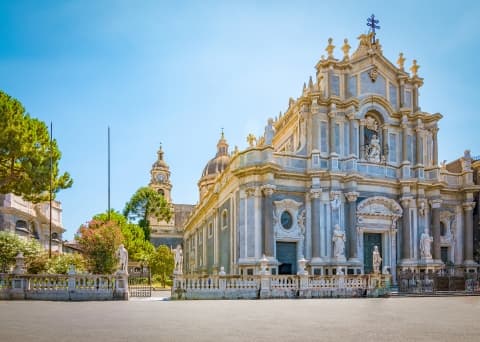
Baroque architecture, on a grandiose scale, and with whimsical features, delight visitors in Sicily's southeastern hill towns.
Sicily beckons to travelers for so many reasons. Many of them reflect blessings of Mother Nature. The island is surrounded by crystalline seas, there's a volcanic mountain you can hike, and the farmland yields the freshest of vegetables, superb citrus fruit, cheeses made from sheep which graze on rugged hills and bountiful catches of fish from the Mediterranean, all of which, in some variation, can be found in the wonderful Sicilian cuisine.
But there is also its sublime architecture. Sicily's southeast corner of hill towns full of palazzi, villas, churches and fountains and monuments that are splendid, grandiose and often bizarre examples of imaginative and impressive Baroque style.
There is no shortage of Baroque splendor in this part of Sicily. Indeed, this wealth of Baroque architecture -- so different from much of that on mainland Italy -- inspired UNESCO, the U.N. culture agency, to put a cluster of hill towns in a valley on its World Heritage List deserving of special protection and attention.
You might want to sample two or three towns in day trips. Or perhaps devote an entire week or more since each town has its own character. One possibility is to base yourself in a nearby sea town to stretch your legs on sandy beaches or along panoramic promenades after climbing the steep streets of these towns, it's easy to customize a holiday built around Baroque immersion.
Baroque found its opportunity in Sicily after the 1693 earthquake, which leveled centuries of public buildings, churches, villa, Reconstruction was fueled by a fervent determination to erect dazzling monumental buildings, as if testimony to the proud new to forge a new cultural legacy.
Scicli is one of those Baroque gems, a town with layers of history. Under Sicily's Norman rule, it was a royal city, perched on a high vantage point to keep watch over a strategic river. But after centuries of glory, a plague in the early 1600s and then the quake, left the town devastated. The city rebuilt itself gloriously. Visitors can see the "new" churches and palazzi by climbing streets seemingly more designed for mountain goats. The local elderly residents, smiling and nodding, walk effortlessly past breathless tourists.
Among Scicli's highlights of the local, late-Baroque style is Palazzo Spadaro, built during the 18th century. It is striking for its eight iron rail balconies featuring floral and geometric motifs. The railings apparently allowed a passerby to look up and appreciate the sumptuous dresses of the ladies of that era. Interior highlights include splendidly colored ceramic tile flooring made in Caltagirone, a Sicilian hill town famed for its decorative tiles.
Displaying how Sicilian Baroque architecture and decoration went wild, so to speak, compared to what was happening on the Italian mainland is Palazzo Beneventano. A delightful feature of this palazzo and of many others in Scicli are the carved fantastical stone animals that decorate "mensole" or "'shelves" supporting the balconies. Arches around windows are dressed up with "mascheroni," whimsical or eccentric face figures. On another Scicli landmark, Palazzo Fava, the "mensole" sport carved griffins, winged horses and bearded figures.
Break up your Baroque tour with a refreshing walk in one of the town squares. If the weather is warm, order a granita, or shaved ice treat made with whatever fruit is in season, such as luscious gelso (mulberry), or get a caffeine boost with a coffee-flavored granita. Fans of the wildly popular TV series, Inspector Montalbano which follows the fictional local police chief Commissario Montalbano and is based on a character created by best-selling author Andrea Camilleri, will recognize backdrops frequently used in the filming in Scicli and several other Baroque towns nearby.
Chocolate lovers will want to put Modica on their Baroque-to-see list. Consisting of an upper and a lower town, Modica is home to the Church of San Giorgio, approached by a grandiose staircase. Modica's main street is lined with shops of chocolate makers, each, it seems claiming to be several more generations older than the other. Many allow tasting of the various flavored chocolates.
The classic Modica chocolate bar is rich and grainy, almost crumbly, running to bitter on the taste range. It lends itself well to being shaved over ice cream, yogurt or atop cakes and keeps long in the refrigerator. One local favorite features orange flavor, reflecting the excellent production of Sicilian citrus. At this writing, Modica's chocolate "sagra" or festival dates for 2018 hadn't been announced yet, but past years have seen it held in early December.
The list of towns is a long one, but if only two or three will be your destinations, Ragusa is a fine choice. Like Modica, it also consists of an upper and a lower town, Upper Ragusa, or Ragusa Superiore, has one of the few churches to survive the quake, 14th-century Church of Santa Maria delle Scale. "Scale" means stairs, and this staircase has 242 steps leading to a terrace with a dazzling view of the lower town, known as Ragusa Ibla.
The lower town boasts the Church of San Giorgio, designed by one of the Baroque masters who worked in the area, Rosario Gagliardi of Noto. Many experts of the local architecture tag Noto as perhaps being the star of all the towns, with the cathedral and Church of San Domenico star attractions.
If chocolate rewards Modica's visitors, Ragusa's treat is the nearby Marina di Ragusa, a casual seaside town with sandy beaches. A strategically placed bike rental shop makes it possible for visitors to take to two wheels for exploration of a string of charming villages along the Mediterranean, many of them simple trattorie serving the fresh catches of the day.
For those wanting to appreciate Baroque touches off the more noted tourist path, all it takes is some careful observation along town strolls. For instance, whimsical carved monster heads abound, like the ones adorning the balconies of the city hall in the town of Acireale, near Catania. The Palazzo Modo' in Acireale sports "mascheroni" with gaping mouths.
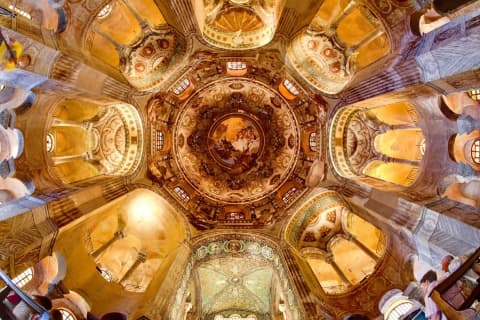
Ravenna in all its Byzantine glory rivals the mosaics of what was Constantinople.
Ancient, Medieval, Renaissance, Baroque. Italy abounds in art and architecture from all these periods. But the style "Byzantine" perhaps comes less frequently to mind when citing Italy's artistic marvels. While there are some fine mosaics to admire elsewhere, including in some of Rome's ancient basilicas and other churches, Ravenna is unrivaled in Italy.
Indeed, the city near Italy's Adriatic has no match in Western Europe for its abundance of stunning mosaic decorated in the Byzantine style.
While, now inland, Ravenna was once a bustling port on the Adriatic Sea and home to the imperial court until their eventual move to Rome. Then began a period of heady artistic glories, which now invite visitors to revel in the exquisite detail and color of decorative mosaics. The decorators were top-class: among them was the sister of Emperor Honorius, Galla Placidia, and later, by Empress Theodora when the city prospered under the Eastern Empire.
Considered by some to be the top example of Byzantine art in all of western Europe is the basilica of San Vitale. Its very shape is striking -- octagonal -- and the building is topped by an octagonal-shaped cupola, or dome. In its mosaics, features of eastern and western art traditions merge.
Nearby is the mausoleum of Galla Placidia, whose final resting place was constructed by her brother Roman Emperor Honorius in the 400s. The empress died in Rome instead and so was buried there. Inside golden light filters through alabaster windows, adding brightness to the magnificent mosaics, while a striking blue dominates. In one charming mosaic, a dove is perched on the edge of a bowl of water.
Architecturally unusual for Italy is the cylinder-shaped bell tower of the Basilica of Sant'Apollinare Nuovo, which despite its name dates to the start of the 6th century. The basilica has a gabled facade. Inside are more wonderful mosaic decorations, including one of the biggest monumental cycles of New Testament themes.
Another basilica, Sant'Apollinare in Classe exudes a kind of solemn aura. It's a bit out of the center of Ravenna, about five miles away. Some have described it as one of the most impressive basilicas of the early Christian era. It is home to ancient marble sarcophagi of bishops, positioned along the aisles.
There's more… Theoderic built a mausoleum, in 520 A.D., as his own burial place. It features two decagonal tiers one atop of the other, with a big dome atop it all. A porphyry tub, the presumed burial place of Theorderic is on the upper level, but his remains are no longer there.
If all these dazzling mosaics begin to dizzy you, it's easy to take a respite. Ravenna is a short distance from the seaside, and the Adriatic coast abounds in beaches.
For a small-sized city -- about 150,000 inhabitants -- Ravenna is particularly rich in culture, mainly due to one of those inhabitants, orchestra director Riccardo Muti. The Maestro has made Ravenna his home since 1976.
Over his career, Muti has dedicated much of his energy to transmitting his talent and passion for conducting to young people. The Luigi Cherubini Youth Orchestra he established in 2004 has its home in the northern city of Piacenza, but it has held its summer festival in Ravenna. So lovers of wonderful music might want to check the festival's website to see what might lie ahead for future summers (www.ravennafestival.org/en/the-festival/).
Heavenly mosaics, sublime music, and, why not, a refreshing day at the mare (sea) might make for a memorable holiday in Ravenna.
Sicily invites exploration on so many fronts -- cuisine, art, architecture, archaeology -- all reflecting settlers and conquerors who left their mark, Phoenicians, Romans, Arabs, Normans and Baroque-era rulers, among them.
But the Mediterranean island also begs you to stay put, slow down, swim in crystalline seas, savor a fresh-fruit homemade granita (a refreshingly cool cafe treat in summer), shop for the fish or vegetables you will have for your dinner that night while strolling vibrant markets alongside friendly locals.
Even allowing two weeks for the "classic" tour of Italy can leave you wanting more.
So, consider a "sampler" of Sicily, one of its enchanting, charming islands of its coast, with all the charms Sicily itself has to offer, from panoramic sunsets, history at your fingertips and meals made from what just came out of the sea or garden down the block that morning.
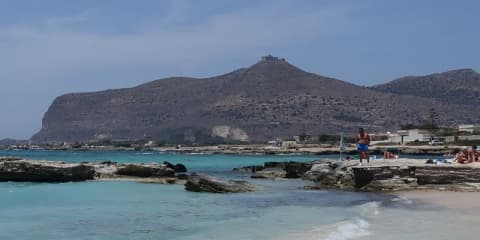
Favignana, an island in the Egadi archipelago nine miles off western Sicily's coast, is small enough to let you bike around it or circumnavigate it in a local fishermen's gaily-painted wooden boat in a morning. But it is also varied enough to offer exquisite dining, seaside choices ranging from sandy coves to cliff-side perches, some of the best scuba-diving in southern Italy and dramatic history dating back millennia.
Easily reached by ferry or hydrofoil from Trapani, a sleepy port town where seafood couscous dishes express both the bounty of nature and the legacy of former rulers, Favignana seduces visitors above all with its simple rhythms.
Perhaps enjoy some Sicilian biscotti made in the local bakery and a coffee in a cafe in the morning in the island's principal piazza where, after only a couple of days, you feel like you have met all the few thousand islanders, since so much daily life -- and night life -- happens there. Or pedal a rental bike to a cove where you can wade it seems forever before it's deep enough to swim. Or take a stroll to peek down into islanders' gardens -- down, because, to shield flowers and citrus trees and vegetables from the warm wind known as the favonio that blows across the island, they cultivate plants below street level in areas carved out of the hauntingly wind-carved tuff.
Centuries before you might consider a trip there, some of the ancient world's most powerful civilizations set their sights on Favignana, too. Phoenician merchants brought ceramic pottery to the island to barter. But Favignana was the backdrop for one of the most celebrated and fiercest naval clashes, the Battle of the Egadis, in 241 A.D., part of the 1st Punic War, which saw the ancient Romans defeat the Carthaginians. So bloody was the battle that a popular spot along the coast, "Cala Rossa," or Red Cove, supposedly takes its name from the bloodstained waters of that clash.
While Favagnana's peaceful now, and the Mediterranean sea that surrounds it ranges in huge from rich sapphire blue to emerald green to Caribbean-like turquoise, a much more recent practice attracting visitors, also turned its waters blood red.
The island's red-fleshed bluefin tuna -- so choice that floating Japanese fish processing plants sail to Favignana to buy the largest specimens if they haven't caught the tunas before they can reach Favignana for sushi -- was legend in even in prehistoric times.
In a sea grotto of Levanzo, Favignana's smaller neighbor in the archipelago, visitors can see 2,000-year-old wall paintings including depicting tunas.
In more recent centuries, tuna fishing and processing in a fish factory dominated Favignana's economy. Every late spring, usually in May but sometimes June, local fishermen known as "tonnaroti," gathered before dawn near the port to catch bluefish, some weighing hundreds of pounds, in a bloody, impressive ritual known as the "mattanza," or slaughter.
It is not a scene for those with weak stomachs. The fishermen chant in local dialect begging God to help them find save ports and calm seas. Their leader is known as a "rais," a honorary title often handed down from generation to generation on the island and dating back more than a millennium when Arab conquerors fished in Sicily's waters. The rais calls out: "may 4,000 tunas enter this night" into their nets.
By a series of maneuvers, fishing nets set deep in the water are brought in closer and closer together, essentially forcing the tunas to run a maze until they are trapped in a four-sided net with bottom, their "death chamber," as it's called on the island. The "tonnaroti" start harpooning and hoisting their catch, fish blood turning the waters a crimson color.
For years tourists came for weekends, hoping to catch the spectacle. But over-fishing in deeper seas and pollution have been blamed for a steady dwindling of tunas, and a decade ago, some springs passed without even one "mattanza." A year ago, the ritual was revived for the sake of tourists, with the tunas captured, but then released to the sea.
Tuna reminders are all over the island. Menus feature pasta sauce made with fresh tuna and tomatoes, raw tuna is sliced for antipasti, and the fish couscous of two sisters who ran what for decades was just about the only lodging on the island drew diners from "mainland" Sicily.
Another pasta dish is made with dried tuna roe, known as bottarga, which make for a pungent-tasting sauce.
But it's not all tuna on the menu. Sword fish joins tuna on the grill or becomes part of pasta sauce or fish stews. For non-fish-lovers, locally caught vegetables top pasta and take their place on the grills, too.
Reminders of how dependent the island's economy had long been on tuna abound. What was once the Florio factory, constructed in 1859 by a Genovese,and later passed to the Florio family, is a cavernous structure that dominates the stretch of coast near town. The Villa Florio, named for the family, rises elegantly, three stories high, is a town landmark.
But much of the architecture iconic to Favignana consists of stark, chalky-white tower like structures, the remains of tufo quarries that furnished building material not only for the Egadi islands, but much of western Sicily. But while the tufo-dotted landscape can seem stark, suddenly between the outcropping you can spy a slice of inviting, sparkling blue sea.
Early visitors knew how to build on the island. What survived of an ancient Roman building, possibly a defense structure erected in the first or second centuries, stands near a nameless church built in the 12th or 13th centuries.
Because of its mild, dry climate, Favignana is fine to visit in spring, summer or fall, with water often warm enough to swim in in early autumn, too.
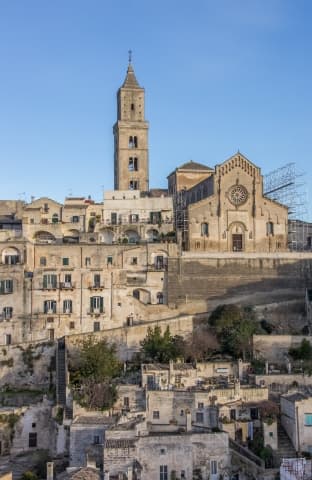
Europe's culture capital in 2019 is an ancient Italian town so old that its stony roots are solidly grounded in paleolithic times. Yet, Matera, a spectacular hill town an easy drive from the trendy Puglia region, is very much projected in the future
Its famous "sassi" -- dwellings carved out of caves and natural stone along steep inclines overlooking a torrent -- were just a half-century ago synonymous in literature, documentaries and social studies with primitive, southern Italian poverty. Lately, Matera's "sassi" are being snapped up for hotels, boutiques and homes for the well-to-do, including architects, photographers and others inspired by breathtaking views to design modern-comfort homes while preserving stone structures dating back centuries.
In the last century, it seemed like Matera, inhabited for thousands of years, would become a stark ghost town. "Cristo si e' fermato a Eboli," Carlo Levi's landmark memoir-book of the physician's, writer's and painter's exile during Italian fascism, introduced to much of the world, including to many Italians in the north, the abject poverty and backwardness of many of the "contadini," or country folk, in the remote mountain villages of Basilicata, a small region of stupendous nature and hardy natives, in the "instep" of the boot-shaped peninsula. For those who didn't read the book in Italian lit classes, there is the 1979 film of the same name, by director Francesco Rosi and with Gian Maria Volonte' starring as Levi. For those planning to experience Matera, one of Basilicata's two provincial capitals, reading the book or seeing the movie is great preparation, for it will make the contrast between ancient Matera and today's Matera even more impressive.
Matera is fascinatingly explored on foot -- unless you have a mule as many residents used to transport themselves or goods. The roofs of "sassi" become roads for the upper parts of the town, which seems to rise ever higher, giving amazing views of the Gravina torrent below and the other part of town across the valley. Matera appears as a bony warren of a place that seems to go on forever. Matera has been likened to Cappadocia in Turkey for its unique complex of cave dwellings.
After Levi's book was published as a introspection of his internal exile in Basilicata, photographers poured into Matera to document what appeared to be an odd and anachronistic way of life. (A photo exhibit entitled "Matera Imagined" with some wonderful scenes of everyday life, lending dignity as Levi did, to the local inhabitants, was put on display at the prestigious American Academy, in late 2017, in its headquarters on Rome's Janiculum Hill; the exhibit moves to Matera's Lanfranchi Palazzao, a painting gallery, where it runs through Feb. 4, 2018.)
With Basilicata's rural poverty a shameful blot on Italy's image, a major energy company built a new section of town, with modern-day conveniences. Many of the "sassi" emptied out, with residents moving to newer dwellings.
But others stayed, clinging to their homes with natural stone for walls and roof, and with only a small "window" letting in light above a solid wooden door. Generations had lived there, often along with their animals, as the stony structure of the town meant precious little space for the likes of barns or pens.
Recognizing Matera's architectural, social and cultural value, the U.N. culture agency UNESCO put the town's "'sassi" and primitive churches on its World Heritage list two decades ago.
Tourists today can spend hours or even days exploring Matera's past and present. High in interest are several churches built eight and nine centuries ago. The cathedral dates to the 1200 and features a rose window, typical of the Romanesque style found in Puglia. The church also is famed for a fragment of the fresco of the Madonna della Bruna, patron saint of Matera.
Matera's churches are carved out of omnipresent 'tufo," tuff, or from natural caves. Some of their locations date back to settlements of ancient monastic communities, and ghosts of their presence seems to pervade even today to those wandering on rugged, narrow stone trails on the town's outskirts. Its "chiese rupestre' are perhaps the most striking of its religious heritage, some dating back to the 9th century, such as the cave church of St. Barbara, a primitive place indeed still conserving its frescoes.
The churches are suggestive of Matera's history reflecting cultural influences of East and West. Straddling the 1st millennium A.D., Greek and Latin communities settled along the ravines, Ancient Greeks left traces of the Magna Grecia era on the town's provincial outskirts. Among other civilizations leaving their influence were the Saracens, Normans and Swabians.
There is also a castle on a hill looking down at Matera. The unfinished building was begun in the late 15th century by a tyrannical rule, Count Tramontano. He was killed in a popular revolt on a street whose name reflects its bloody past -- Via del Riscatto" or "Vengence Street."
Today, shops with pottery, local foods and other souvenirs occupy some of the "sassi." One popular souvenir reflects times in Matera when families brought their unbaked bread to comunal bakeries, embedding in the confection a letter formed out of dough reflecting an initial of each family, so they could "recognize" their own bread when the baked goods were pulled out of the oven.
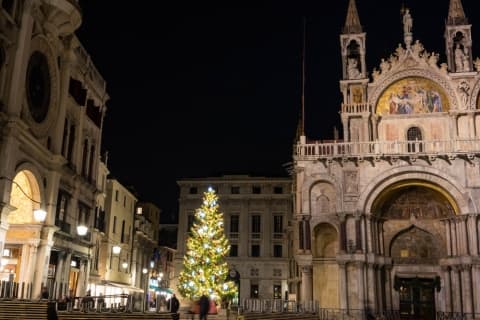
How does Santa come to Venice? On a gondola, of course!
While the splendor of St. Peter's Basilica on Christmas Eve is arguably the time and place most associated with Italy during holiday time, other cities and towns celebrate the season in their own ways, some old, some new, like the Venetian edition this year.
A fresh initiative called "My Venice Christmas" has solidly put the Lagoon City on the Italian Christmas treat map. The heart of the celebration is the "sestiere" or district of Dorsoduro, one of Venetian's most inviting sections to explore, as it lies between part of the meandering Grand Canal and the much wider Giudecca Canal. In Italy, the Christmas period ends on Jan. 6, the Catholic feast day of the Epiphany, commonly known as the feast of the Three Wise Men. But in Italy, Jan. 6 is the day of the Befana, the broom-riding witch who brings children who behave treats and those who don't lumps of charcoal. So "My Christmas Venice" runs from early December through Jan. 7.
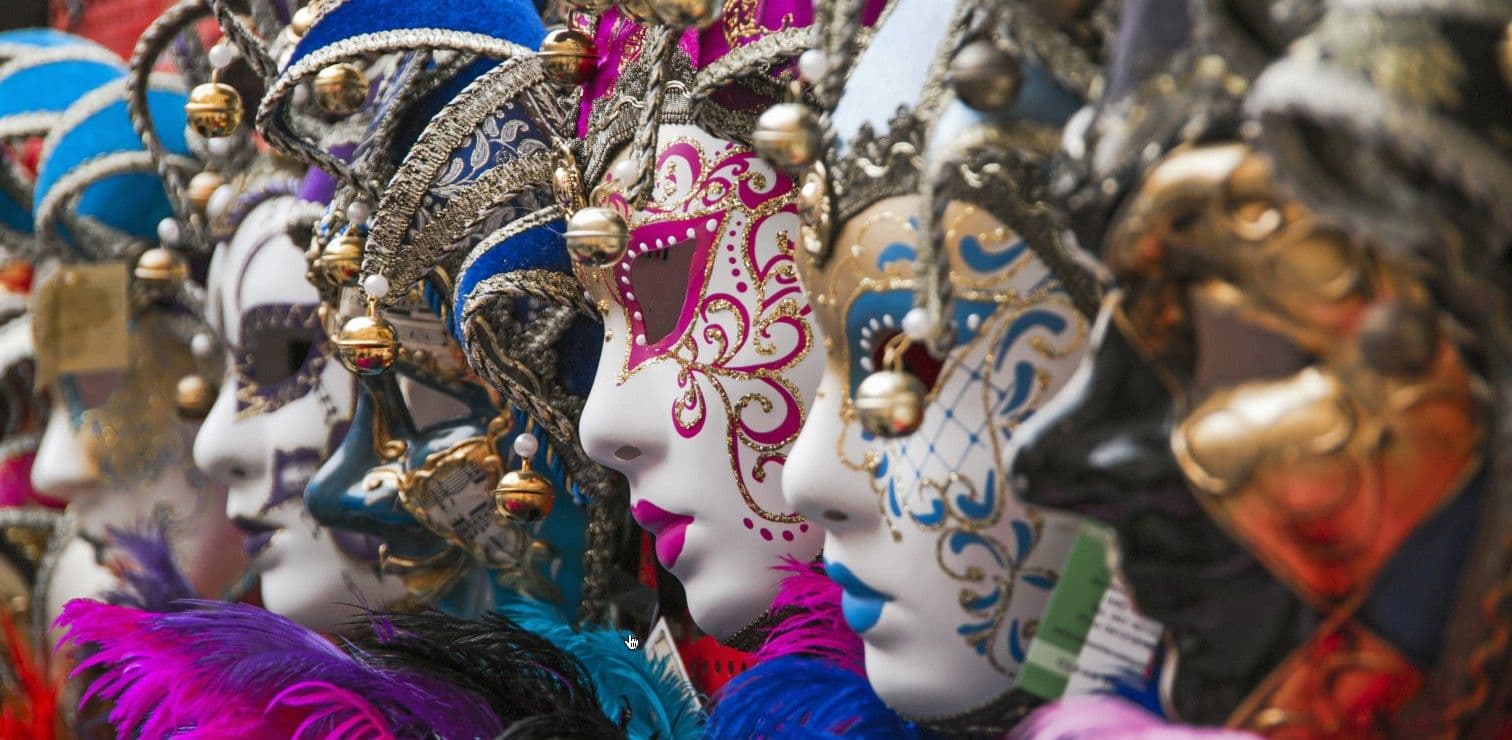
For three weekends, in the late 17th-century Zenobio Palace there will be a holiday market place. Also on tap is entertainment, including dance and performance and workshops such as Venetian mask-making. Just strolling Venice at night is joyous, as the shimmering reflection of holiday lights strung above the canals between tiny streets render a walk even more enchanting. Gospel and pop concerts are among the offerings.
Most of the merry-making takes place in the area roughly running between two of Dorsoduro's main landmarks, notably the Accademia gallery of art treasures and the domed, 17th-century basilica, Santa Maria della Salute, at the very tip of the sestiere.
The brainchild of a hotelier in the Dorsoduro district, "My Venice Christmas" is billed as a "first edition," so it is worth keeping in mind for future trips to Italy at holiday time.
Of course, every town and for that matter just about every church in Italy makes a show of its Nativity, or creche, scene, so many Italians, especially with children, duck into local churches for a sampling of the local creativity.
And if you happen to be in the vicinity of Bologna, the eve and evening of Epiphany, giant straw puppets some three stories tall are set ablaze in a roaring bonfire to the delight of spectators in the countryside of San Matteo della Decima. Instead near St. Agata Bolognese, fireworks and music accompany the Befana bonfire.
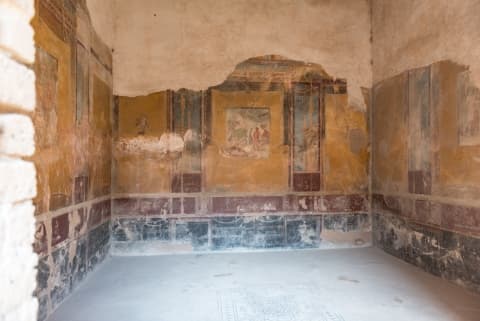
Can a dead city be reborn twice? In the case of Pompeii, the answer is shaping up to be yes.
The ancient Roman city, a bustling, lively place of artisan workshops, stores, eateries and residences near the Bay of Naples, experienced its "first" death when, in 79 A.D., Mount Vesuvius erupted and buried much of the population under volcanic stone and ash. It gained a new life of sorts when, in the 18th century, excavations began, a work in progress leaving roughly half of Pompeii still to be revealed.
But the last few decades saw the sprawling archaeological site, and one of Italy's its most popular tourist attractions – Pompeii drew more than 3.2 million visitors in 2016 – risk a modern-day death.
Parts of walls that had survived for nearly 2,000 years crumbled. One especially dismaying collapse, in 2010, involved the House of Gladiators, so-called because that's where they trained and deposited their weapons. In one of a pair of collapses in 2014, the wall of a tomb in a necropolis fell down. And in winter 2017, part of a wall in an ancient house -- luckily for posterity not one of Pompeii's spectacularly frescoed ones -- literally fell apart.
Poor drainage has been partially blamed. Other fingers pointed to Italy’s chronically skimpy national budget to care for its extraordinarily rich patrimony of monuments, art and archaeological ruins. Other human factors played a role in the damage. In such a vast site, Pompeii’s custodians just aren’t numerous enough to make sure tourists don’t chisel away ancient mosaic tiles, flake off fresco fragments or deface the ruins with modern graffiti. It didn’t help that some unions of the custodians, irked by management’s efforts to make them more productive, not infrequently went on strike.
A concerned alarmed European Union decided to fund an ambitious effort, the Great Pompeii Project, to both preserve the site while keeping the attraction open to visitors. But at one point, the EU had to sound a warning that Italy would lose the funds unless it didn't promptly and properly used the money. About the same time, UNESCO, the U.N. culture agency, warned it might remove Pompeii's designation as a World Heritage site.
But, happily, Pompeii is experiencing the start of a much needed renaissance..
To great fanfare, a number of "domus" sites, Latin for residence, were put back on the tourist itinerary, some after decades of closure. Archaeologists and restoration experts completed work on them, allowing parts of the site that were too dangerous to permit visitors to be accessible again.
Among the spectacular "new" attractions is the restored Villa of Mysteries, full of well-preserved frescoes on Pompeii's outskirts.
Noteworthy among re-opened sites is the Julia Felix domus, thought to have been a luxury hotel, with a thermal bath complex. (An inscription on one of its doors reads "At Julia Felix's place, an elegant bath, worthy of Venus" can be rented by "proper persons.")
Also now able to be visited is the House of Venus on a Seashell. The name of this "domus' derives from a fresco depicting the goddess on a red shell. The domus had been damaged by World War II bombing.
Another welcome opening is House of the Orchard, with frescoes evoking a garden.
One more novelty for tourists who haven't been to Pompeii in years is the Fullonica of Stephanus, where the locals brought fabrics to be washed or dyed, a kind of forerunners to present-day cleaners.
And right before Christmas 2016, Pompeii lovers had a present: the partial re-opening of the House of the Vettii, which had belonged to two well-off merchants.
Pompeii still yields fascinating reminders of its ancient inhabitants. Late last year, news came that European archaeologists had found four skeletons, gold coins and a delicate, gold-leaf-foil pendant in the back of a shop that apparently had escaped the notice of someone ransacking the shop after the eruption, on the outskirts of Pompeii.
Pompeii’s management doesn’t want to repeat the problems of having too many sites to guard while the attraction is over. So authorities have decided to open up only some of the “new’’ domuses at a time, meaning what you see will depend on when you come.
But that can work. Pompeii’s vastness can almost overwhelm, and be too much of a good thing to absorb in one visit, especially when traipsing under a hot summer’s sun.
Pompeii also now offers temporary exhibits or gives rare opportunities to see parts of the site are rarely open to the public. For example, to mark Valentine’s Day, visitors could enter the ‘’House of the Chaste Lovers’’ during a five-day weekend only. The house takes its name from a modest kiss exchanged by two lovers in a fresco decorating the dining area.
In one popular but temporary exhibit, the remains of carbonized bread, grapes and figs that Pompeii's doomed inhabitants never had a chance to eat were put on display.
Pompeii's Antiquarium, a 19th-century structure that was damaged in the 1943 bombing, then repaired, only to be closed again after the 1980 Naples-area earthquake, was inaugurated in April 2016, offering visitors a space to learn about the ancient city's history, even in the centuries before its destruction by Vesuvius.
The once-buried city still amazes visitors today with its ever-unfolding revelations and surprise offerings.
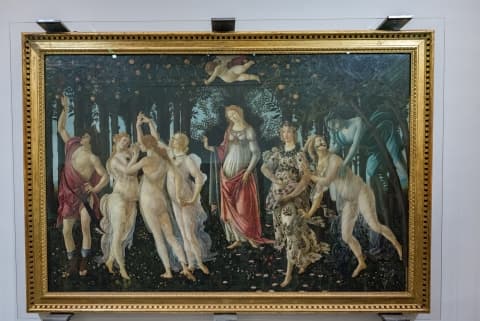
The Uffizi Gallery, Florence's treasure trove of Renaissance masterpieces, is experiencing its own renaissance of late.
After a much-awaited renovation, the art museum's signature attractions, Botticelli's "Spring" and "The Birth of Venus" can be seen in a new light, literally. The exhibition spaces, which are generally referred to as the Botticelli rooms, in homage to the iconic works by the early Renaissance painter, were given a months-long overhaul with the goal of improving the visibility of the paintings they host and better channeling the flow of visitors who inevitably clump around the two paintings.
The framed paintings are now displayed in niches, cleverly designed to resemble frames themselves and to help keep viewers' attention focused on the artworks. The lighting seems more natural, and in part it is -- filtering down from above through a newly created false ceiling.
An added bonus are two additional Botticelli works on display just beyond the "Spring" and "The Birth of Venus" room. One is a 21-foot wide fresco, the artist's interpretation of the "Annunciation," which he painted in 1481 for the Hospital of San Martino in Florence. Visitors can compare this work to another Annunciation scene by Botticelli, a painting on wood, which the artist did for a church about 10 years later.
What's happening at the Uffizi -- and several of Italy's other renowned art museums -- is close to revolutionary.
That's because the directors now in charge of them were chosen after a search that for the first time reached out across the globe. . Italy's museums are part of a very clubby world, and while many an Italian curator has gone on to work in prestigious art institutes around the globe, the nation itself had long been fiercely nationalistic when it came to selecting the heads of its own state museums.
So when Italy's culture minister, Dario Franceschini, announced that 20 of Italy's top museums' top jobs were up for grabs, including at Milan's Brera painting gallery and Venice's Accademia, and that qualified candidates from abroad were encouraged to apply, many in Italy worried that somehow that their art institutions would somehow lose character, go too commercial or betray the country's deep appreciation for its centuries of masterpieces.
Eventually, seven of the 20 jobs went to non-Italians, as Franceschini looked for candidates with creative visions, eager to update the country's museums. The appointment receiving the most fanfare was the director at the Uffizi, Italy's premier art museum and its top draw, attracting more than 2 million visitors in 2016.
Chosen to head the Uffizi was Eike Schmidt, a German art historian whose resume included positions at the National Gallery of Art in Washington, D.C., the J. Paul Getty Museum in Los Angles, a stint at Sotheby's London, and head of the decorative arts, textiles and sculpture at the Minneapolis Institute of Art. Part of his academic perparation included deep scholarship of the Medici collection kept at the Uffizi.
Visitors stand a decent chance of seeing him. When the Uffizi's air conditioning system broke down one day during Italy's 2017 seemingly endless heat wave, Schmidt came outside to explain to the crowds who had to leave, and those who couldn't get in, what had happened, and how they could get refunds or obtain fresh tickets.
Schmidt is aware that the Uffizi's stellar popularity could also be its drawback. Tourists quickly fill up the space outside the entrance, in lines waiting to buy a ticket, although, for a price, tickets can be purchased in advance for timed entrances.
Shortly after he took up his post, he addressed crowds, though a loudspeaker, warning them to be on the lookout for pickpockets. For his trouble, he paid a price: the city of Florence fined him nearly 300 euros for "broadcasting" without a license! He won over Florentines by paying the fine out of his own pocket.
Schmidt has made clear he wants to discourage the kind of visits he likens to consumers who dash inside some eatery to grab fast food on the run. In the Uffizi's case, that means tourists who come really just to see the Botticelli twin masterpieces and not much else.
Schmidt recently announced the Uffizi's new pricing regime -- which might please those willing and able to pay for more leisurely viewing but which might make those on more careful budgets wince.
He hopes the new new pricing strategy will encourage tourists to linger, exploring the collections not just in the Uffizi, but also in all its galleries, including Pitti Palace across the Arno and the Boboli Gardens.
Starting in September the cost of a one-day entrance ticket was set to jump from 8 euros to 12 euros during "low" season in winter, and surge to 20 euros the rest of the year.
But the Uffizi is also starting three-day passes, to the Uffizi, Pitti Palace and gardens, which date back to the 16th century, and which delight with its grottoes, statues and fountains. Cost of a three-day pass will range from 18 to 38 euros, and includes priority admission.
For those who can't get enough of Florence -- or the Uffizi, a year's pass will be available, at 50 euros.
While the prices are steep, under Schmidt's direction, the Uffizi is trying hard to please. For six months, visitors this year were given the opportunity to admire Leonardo da Vinci's "Adoration of the Magi" on display after a five-year-long restoration, which brought to light unexpected shades of color and details, including pencil tracings by the master, as he worked out the drawings perspectives. The work, which was commissioned to Leonardo by monks in 1481, but he didn't complete the painting. The painting is on display till Sept. 24.
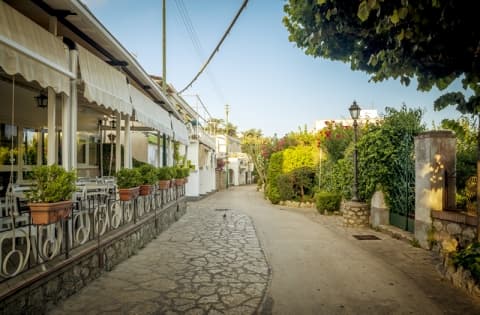
Anacapri
At the end of the day, when it's time to shut off the lights in glittering boutique after boutique, each beckoning with prestigious designer names on Capri's high-end shopping streets, salesclerks hop on their motorini or catch the island's faithful mini-buses. They head to some of the Mediterranean island's most enchanting corners high up on the verdant hills, where islanders make their homes, in white-washed ``villette" lining flower-scented lanes, or within strolling distance of stupendous cliff-side views of sapphire-blue water, a lighthouse, and birds soaring over the seas.
Anacapri is Capri isle's ”other town”, where a sojourn is an idyll for the asking. Even simple rental houses are surrounded by lush gardens; full-fledged villas come complete with pools and servants. Augustus knew he had a choice in real estate when he visited, and traded it for Ischia, a larger island in the Bay of Naples. A later Roman emperor, Tiberius, had several villas constructed to honor the gods on Capri, which became his retirement home.
Even a few hours in Anacapri can be heavenly. While many tourists come up from Capri for a quick look around Anacapri's tiny town center, relatively few take the time for gentle hikes on paths that slip past modest islanders' homes surrounded by vineyards or dotted with lemon trees -- think limoncello -- or wind down roads that seem more like wandering through one big public botanical garden, with a riot of colors and perfumes assailing the senses as flowers spill over fences.
So rare are passing tourists on some of these paths, that if you stop to sniff or photograph up close an exotic blossom, chances are a good local will smile and start chatting, regardless of what language the visitor and islander speak. Anacapri's residents are grateful when visitors appreciate the island's natural beauty that is part of their everyday lives.
Anacapri's more formal tourist delights are few, but richly rewarding. Visitors who wander to the 18th-century San Michele church walk gingerly over a walkway that protects its majolica floor, with a marvelous, imaginatively vivid rendering of Eden.The guardian shows genuine pleasure when tourists respectfully admire the flooring.
And if the gardens and trellises along Anacapri's back streets aren't wonderful enough, Villa San Michele, a house built by a Swedish doctor and writer who lived much of his life on Capri, Alex Munthe, and tastely decorated with antiques, can be toured. The highlight is a landscaped, extensive garden, which invites lingering and admiration of its selection of typical Mediterranean flora as well as plants from other continents, At one end, an overlook presided over by an granite Egyptian sphinx, presents a picture-postcard view of the Bay of Naples. The heart can reach the villa and garden, perched 1,000 feet above sea level, by climbing the Phoenician staircase, or by a short stroll, from Anacapri's center. The villa was built on what was a site of an ancient imperial villa. Tourists can relax at a modest café with sublime views of the seas.
For an even less populated corner of Anacapri, but with more breathtaking views of the sea below, there is the "Belvedere" or panoramic viewing point, at the end of the pleasant Migliara path, reached by following former mule paths, or by paved, rising roads. Belvedere offers sweeping views which encompass the "faraglioni" -- towering rocks which rise ruggedly out of the sea.
Indeed, not far from sophisticated Capri town, hikers can wander on footpaths or better, mule paths, that invite exploration. Swimmers will likely enjoy their dip in the pristine sea by climbing down the ladders of yachts or jumping off colorful wooden fishing boats that circumnavigate the island, although a few paths lead down to tiny rocky beaches where locals take their sun.
Venice by moonlight, Rome under a canopy of stars. Summer in Italy presents special opportunities for romantic evenings and sightseeing in suggestive settings, without wilting under the sun.
After a successful first summer, Venice again this year will extend visiting hours for the Palazzo Ducale, or Doge’s Palace, on Friday and Saturday evenings until 11 p.m. (with last entrance at 10 p.m.) The palace, steeped in the Venetian Republic’s proud history, is extraordinarily rich in architectural details and artworks.
The lagoon city sees the nighttime hours as a way for Venetians, not just tourists to revel in the palace’s beauties. This is wonderful since working Venetians, many of them employed in the tourism sector, can’t make it to the site before the usual closing hours, of 5:30 p.m. in winter and 7 p.m. in summer.
The palace is a masterpiece of gothic style, grandiose while architecturally pleasing, with one of its wings dating back to 1340. There is a Renaissance wing, where the doge lived, which was rebuilt between 1483 and 1565. The palace was also the site of a prison on the ground floor. The main facade features pinkish Verona marble. The palazzo is now home to superb paintings by Veronese, including his famed ‘’Rape of Europe,’’ and Tintoretto’s “Descent from the cross’’ in the Senate Hall, where the doge and his senators used to hold court.
Rome, which can be beastly hot on summer days, opens up two of its most popular attractions – the Colosseum and the Roman Forum – to visitors in late evening.
This year, starting on April 21, the traditional ‘’birthday’’ of Rome, commemorating the ancient city’s legendary origins, the Forum was again illuminated to the delight of Romans and tourists alike. From sunset to dawn, ancient Rome’s glories can be marveled during a leisurely, and why not, romantic stroll along the broad Imperial Forums Way.
Guided night tours of the Roman Forum are being offered in summer, until Oct. 28, on Friday and Saturday evenings. Tours are given in English (and Italian) to groups of 25 upon reservation and the last 75 minutes. Tours begin at 8 pm., with the last ending at midnight. The tour includes exploration of the wall paintings of the early Christian world, with a tour of the Santa Maria Antiqua church, an ancient basilica at the foot of the Palatine Hill. Also featured on the tour is the Oratory of the 40 Martyrs, with decorative painting dating to the 8th-century on its apse. The site pays tribute to Christian soldiers who were martyred -- condemned to die in an icy lake in Armenia -- during the persecution under Emperor Diocletian's reign. Tickets cost 20 euros -- who says romantic atmosphere comes cheap? Reservations at www.coopculture.it
Also able to be visited under the moonlight is the Colosseum. These guided tours may not allow you to spy every crack in the time-worn stones in the arena which symbolizes the Eternal City. But the play of shadows when clouds pass in front of the moon are enchanting, and with the night air temperatures traditionally a relief in Rome, you want to linger and drink in the atmosphere, instead of exiting the arena, perhaps to grab a cold drink. You might want to check your calendar to ensure it’s a full moon to maximize the experience.
This year’s moonlight tours called ‘’La Luna sul Colosseo’’ began on March 11 and run through Dec. 30. First entrance is at 8 p.m., last tour begins at 10:50 p.m. During June, July, August and September the night tours are available daily; starting in Fall, the days of the week for these tours are fewer, whittling down to only on Saturday in December. Reservations are required and can be done at www.coopculture.it
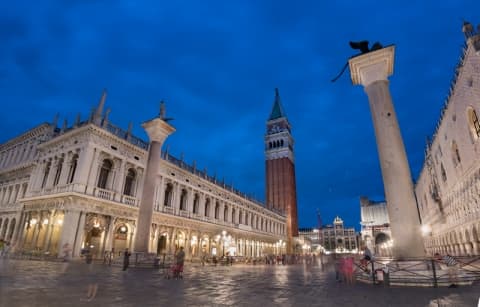
FINALLY, ROME'S CIRCUS MAXIMUS HAS SOMETHING TO CHEER ABOUT
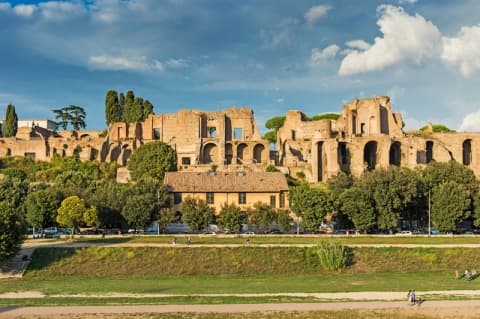
Until late 2016, when Rome’s newest ‘’old’’ tourist attraction was unveiled, visitors could be understandably perplexed about what was so great about the Circus Maximus.
For what had been the biggest entertainment and sport structure of all time had revealed itself to the curious as little more than a vast expanse of weed-dotted field, depending on season, either muddy or caked dry. True, with some imagination, a tourist could picture roaring crowds or pretend to hear them cheering their favorite athlete or jockey, seated in rows, hundreds of thousands of spectators enjoying the spectacle on a 2,000 foot long field.
Now, after six years of careful excavations, tourists have a real, if still partial sense, of what all the fuss was about at the Circus Maximus, which occupies a valley between the ancient Palatine and Aventine hills.
They can stroll through covered walkways that led to the steps of the seats. The plebes went upstairs, the senators on the ground floor, not that much unlike today’s upper bleachers for baseball fans who can’t dole out much money for seats closer to the action and the season-ticket holders or VIPs who snag those coveted box seats. Along the way to seats, just in case if Nature called, latrines were strategically placed, and, the excavation made them visible for viewing.
Along an ancient path just outside where spectators took their seats, were ‘’botteghe,’’ or stores, selling food, snacks or housing money-changers, which would have come in handy in those times for fans who wanted to place bets on horses.
Indeed, the archaeological dig turned up a glass goblet, whose bottom was decorated with the figure of a prancing horse. The horse’s mouth holds a palm branch, apparently signifying that the horse had won at least one race, and the victorious horse’s name, Numitor, is written on it. The find was an exciting one: archaeologists describe it as the only documentation they have that horses were indeed involved in the entertainment at the site for the ancient masses.
Also visible now to tourists are the remnants – still impressive – of what was once the Arch of Titus, considered to be one of the greatest triumphal arches in ancient Rome. The base of several of columns – where, when still standing towered some three-stories high – can be seen. Also revealed by the dig were parts of what was once a bronze inscription on the arch.
Much of the Circus’ glories were carted away over the centuries. One Egyptian obelisk in the 16th century was transferred to the square outside St. John in Lateran Basilica, while the other one was moved to Piazza del Popolo.
A geophysical examination discovered that the original track now lies more than 15 feet below the current surface of the archaeological area.
While the soaring obelisks now longer stud the Circus, visitors to the excavation can climb upstairs the restored, medieval Moletta Tower for a bird’s eye view of the expanse as it is today and get a better sense of the ‘’maximum’’ dimensions of the ancient entertainment site. The field was used by carriages centuries before Julius Caesar’s time that the walls were erected. It wasn’t all fun and games. The tiers of seats also allowed for viewing of public executions.
Nowadays, the vast part of the field outside the fenced off excavated area is the turf of joggers, strollers and dog walkers, and occasionally has hosted track races by local school clubs.
Circus Maximus’ excavations are available for viewing by reservation in guided groups, Tuesday through Friday, by calling 06-0608. On Saturdays and Sundays, the public can enter without reservations between 10 am. And 3 p.m.
There's a special cycling tour in Tuscany offering one-of-a kind views of countryside and putting you literally on top of history. It doesn't require grueling Giro d'Italia level fitness to do it.
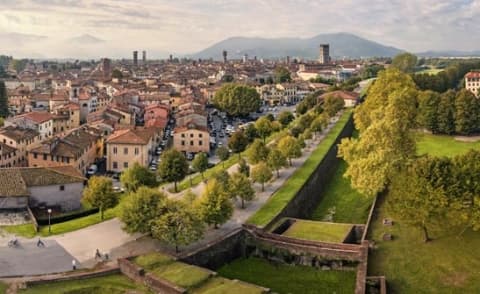
Lucca's 16th and 17th century walls ringing this exquisite jewel of a Tuscan town are the route to follow. But instead of cycling around these walls, you pedal on top of them.
The ramparts enclosing the town in western Tuscany no longer serve for protection. Instead they make for a delightful 2-and-1/2 mile cycling path. The top of the walls double as Lucca's public park. Elegantly-dressed business people pedal to appointments with leather satchels strapped to their bicycle, students leaning forward from the weight of schoolbooks in backpacks ride on their way to class and homemakers balance bags of vegetables, meat and bread on handlebars or tucked into baskets as they do their daily rounds in the morning.
Come afternoon, the pace is often more leisurely. The route atop the walls serves the Lucchesi, as Lucca's natives are known, for promenades, just like seafronts or town squares are the haunts for that late afternoon or pre-dinner "passeggiata, or relaxing see-and-be seen stroll in cities small and large throughout Italy..
Benches stud the pathway atop the walls, meaning even if a gentle spin around the town is too challenging, there are ample spots along the way to rest and reflect on this past of this proud medieval town.
After burning off the calories, trattorie and restaurant beckon in a town boasting some of Tuscany's finest food.
Pastas tend to be hearty but not heavy -- sauces can feature the likes of fresh porcini or rabbit meat. But rustic, lighter fare abound on menus, too, like the faro (spelt) or bean soups, made extraordinary by dribbling on some of Lucca's fine olive oil from bottles left on dining tables.
Tuscans are naturally proud of their rich history, stunning art and architecture and, they will tell, you, of an Italian pronunciation they claim is the purest among Italy's regions. Lucchesi quietly radiate that pride, while being very welcoming of visitors who decide to explore Tuscany beyond Florence and Chianti countryside.
Lucca gives off an air of "benessere" -- being well-to-do. Its rich history sinks back to ancient Roman and Etruscan times, and medieval houses line present day streets. Merchant traditions date back to its location along the silk trading route. Culturally, Lucca is rich, too. The hometown of opera composer Puccini hosts several musical festivals.
One of its art treasures is the sculpture adorning the sarcophagus of Ilaria del Carretto, an early 15th century masterpiece by Jacopo della Quercia. When restoration left it squeaky white clean a couple of decades ago, the citizenry and the art world fiercely debated whether the cleaning went too far, robbing the artwork of its nuances, The acidic criticism even formed the basis for a court suit heard in Florence.